Epifania
70 pounds
Buy this piece
Made by hand, so no two come out the same. A piece can be made again on request — never quite identically.
Ask about this piece- 14-day returns
Details
- Reference
- cora-0047
- Construction
- Wire-linked by hand — every bead turned onto its own eye-pin and closed
Delivery
Pieces are sent within the United Kingdom, tracked and insured, for a flat £12 added at checkout. UK law applies to your order, including 14 days to change your mind. See the shipping and returns page for handling and transit times.
Returns and repair
Fourteen days to return it. Because every link is turned and closed by hand, a single link can be reopened and put right without disturbing the rest of the strand.
Saying, Where is he that is born king of the Jews? For we have seen his star in the East, and are come to adore him.
About this piece
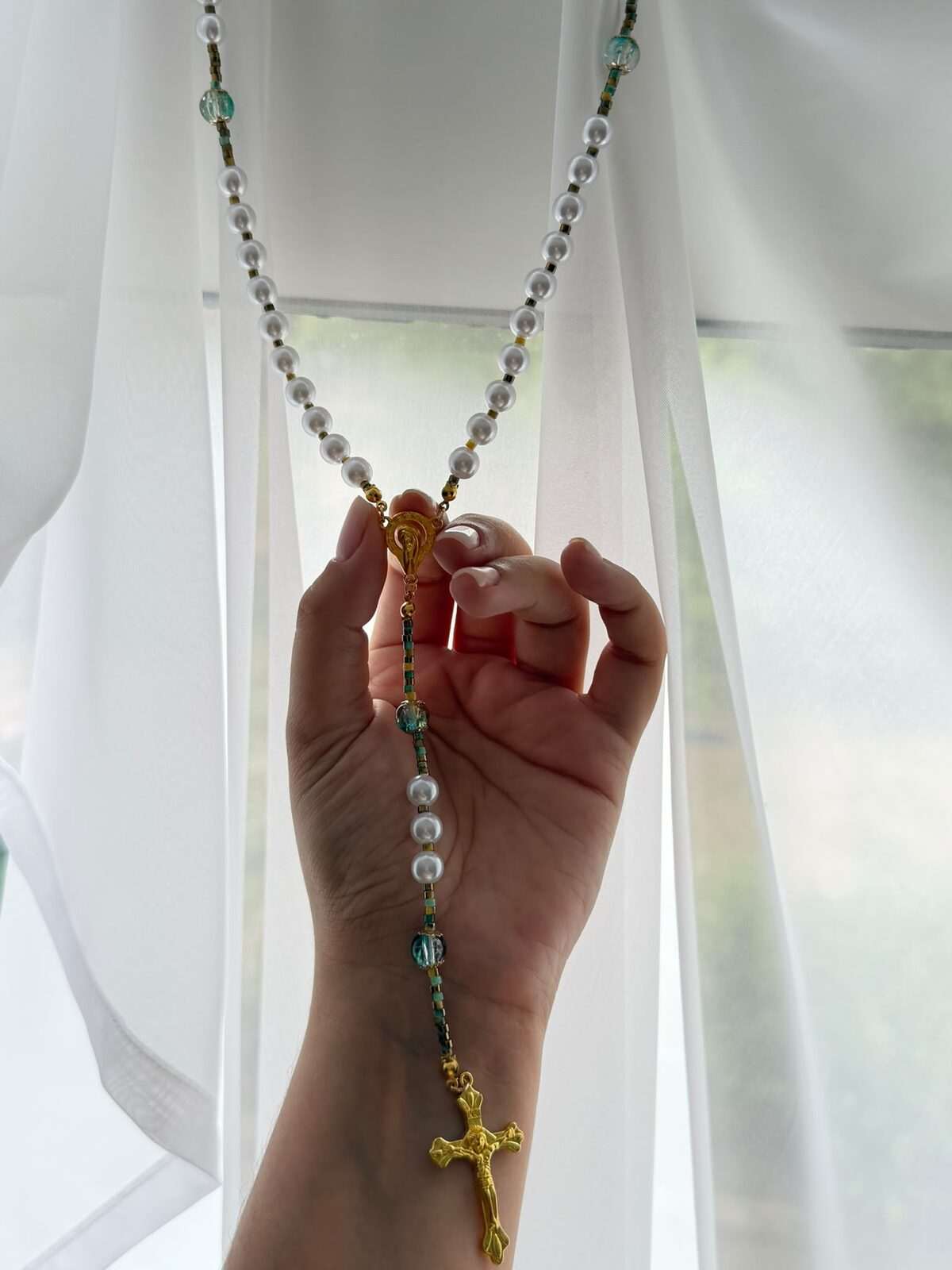
Epifania is the twelfth night, when the kings arrive and the season finally opens out. This one is warm rather than cool — pale nearly all the way, with a green-blue note that keeps returning and a warm-toned figure and cross at the end. It hangs at full length rather than coiling.
White, and the feasts
White is the colour the church puts on when it has something to celebrate. It belongs to Christmas and to Easter, to the feasts of Our Lady, to a baptism, a first communion, a confirmation, a wedding, and — this surprises people the first time they see it — to a funeral, because the Latin church buries its dead in the colour of the resurrection rather than the colour of mourning. Wherever white appears in the calendar, the church is saying the same thing: that this day is not an ordinary day.
A pale run behaves differently in the hand from a dark one. It shows every fingerprint and every crooked link, so there is nowhere to hide a piece of careless work, and it takes the colour of whatever room it is in — warm under a lamp, almost grey under an overcast window, and briefly luminous when a low sun comes through a curtain. That last is how these were photographed, and it is the closest thing to how they look in a church at ten in the morning.
The pale pieces in this collection are all built the same way and read very differently, because a single note of colour carries further against white than against anything else. On one, a green mark at every turn is enough to change the whole mood of it. On another, a deep blue arriving at the larger beads is the only colour there is, and it is plenty. On a third, a deep pink interrupts the run the way a hedge interrupts a field. None of these is decoration. In a strand meant to be told with the eyes shut, a change of colour is a change of texture, and a change of texture is how the hand knows where it has got to.
These are the pieces people buy for somebody else, and for a particular day. If you are choosing for a confirmation or a first communion and want to be traditional without being obvious, this is where to look first. They are also the easiest of Claudia’s pieces to live with afterwards, because white does not argue with anything.
Care and blessing
Your rosary arrives unblessed. A blessing is given freely by a priest and costs nothing — it is not ours to sell, and it never will be.
What you have paid for is the making — meticulous, by hand, link by link.