Horta
72 pounds
Buy this piece
Made by hand, so no two come out the same. A piece can be made again on request — never quite identically.
Ask about this piece- 14-day returns
Details
- Reference
- cora-0050
- Construction
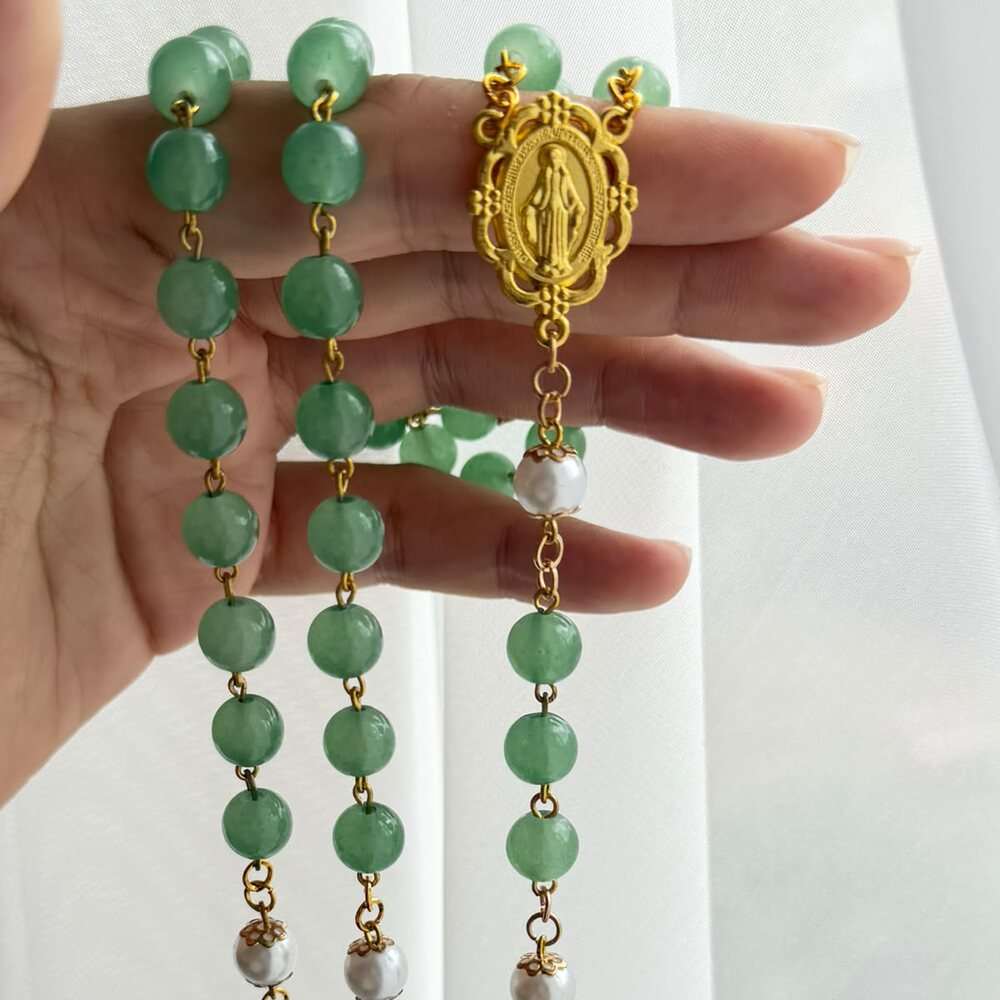
- Wire-linked by hand — every bead turned onto its own eye-pin and closed
Delivery
Pieces are sent within the United Kingdom, tracked and insured, for a flat £12 added at checkout. UK law applies to your order, including 14 days to change your mind. See the shipping and returns page for handling and transit times.
Returns and repair
Fourteen days to return it. Because every link is turned and closed by hand, a single link can be reopened and put right without disturbing the rest of the strand.
My sister, my spouse, is a garden enclosed, a garden enclosed, a fountain sealed up.
About this piece
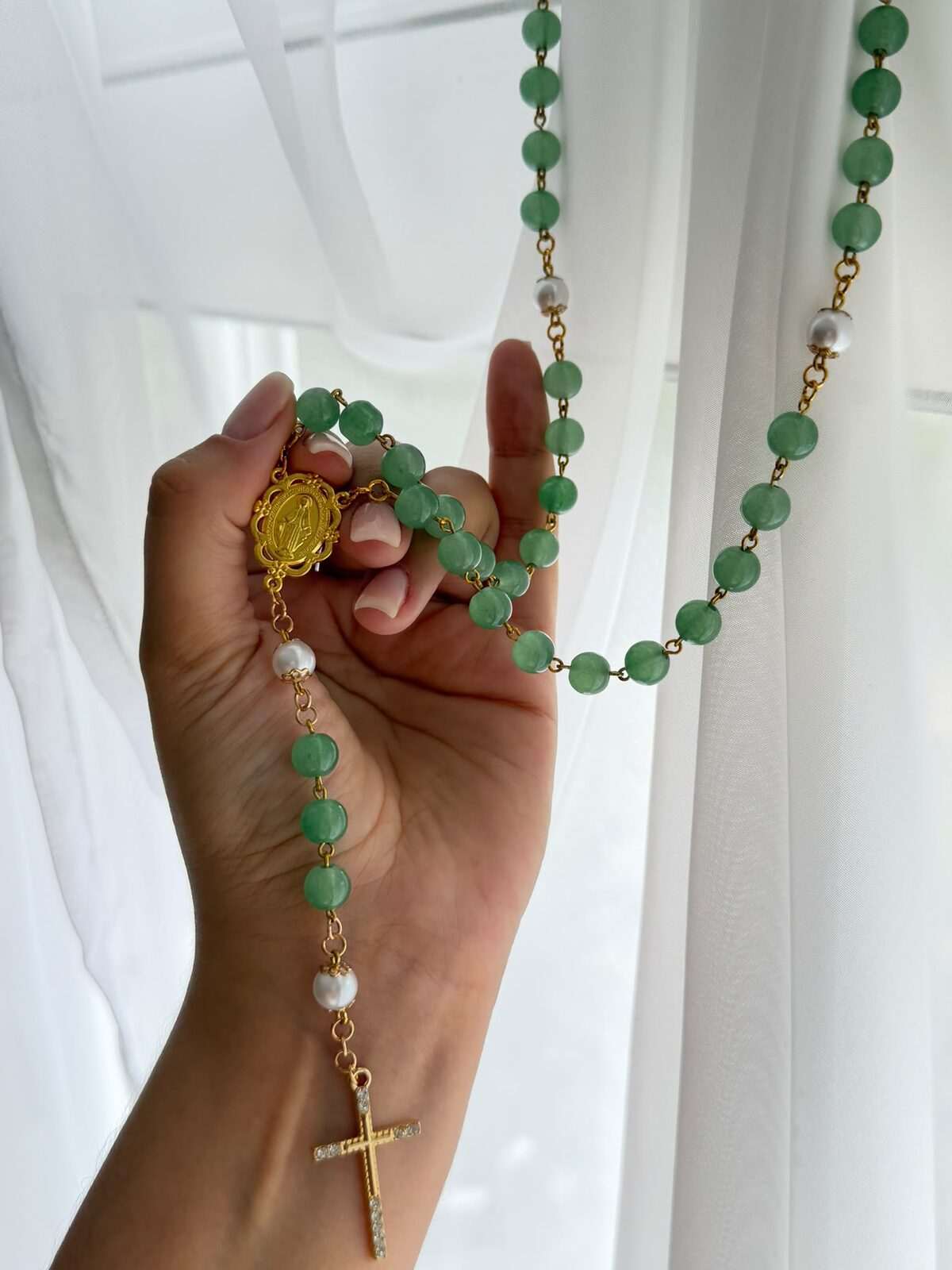
Horta is the kitchen garden — the walled patch behind the house that feeds it. This is the same green, warmer and brighter than the evening piece, run on warm-toned links with a pale round note at every decade. It is the summer one of the green pieces.
Green, and Ordinary Time
Green is the colour of most of the year. Once Christmas and Easter and their seasons have been counted out, what is left is Ordinary Time — thirty-three or thirty-four weeks of it, the longest stretch in the calendar and the one with no festival attached. The name is misleading in English. It is ordinal rather than ordinary: the weeks are simply numbered, and the point of them is that they continue. Green is what the church wears for continuing.
That is exactly the case for a green piece. A rosary is not mainly an object for great occasions; it is an object for Tuesdays. It is the thing that gets told on the same walk at the same hour for years, and the pieces in this group are made for that job rather than for a photograph. They are quieter than the pale ones and less demanding than the dark ones, and they are the ones Claudia says she would keep.
The two green pieces here are not the same green, and the difference is the whole choice between them. One is flat and cool, the colour of a field an hour after the light has gone off it, marked by a single pale note at each turn: a piece for the end of a day, when the work is done. The other is warmer and brighter, the green of a walled kitchen garden in July, run on warm-toned links so the whole thing sits a shade sunnier. One is for evening and one is for summer, and most people know which is theirs within a few seconds of seeing them side by side.
Green does something practical too. It sits far enough from skin tone that the count is easy to see at a glance in poor light, and it does not go grey the way a pale run does under an overcast sky. If a piece is going to live on a hook by a door and be picked up on the way out, green is the colour that will still read as itself in November.
Fifty-nine beads and more, each turned onto its own wire link and closed by hand in London, meticulously, link by link.
Care and blessing
Your rosary arrives unblessed. A blessing is given freely by a priest and costs nothing — it is not ours to sell, and it never will be.
What you have paid for is the making — meticulous, by hand, link by link.