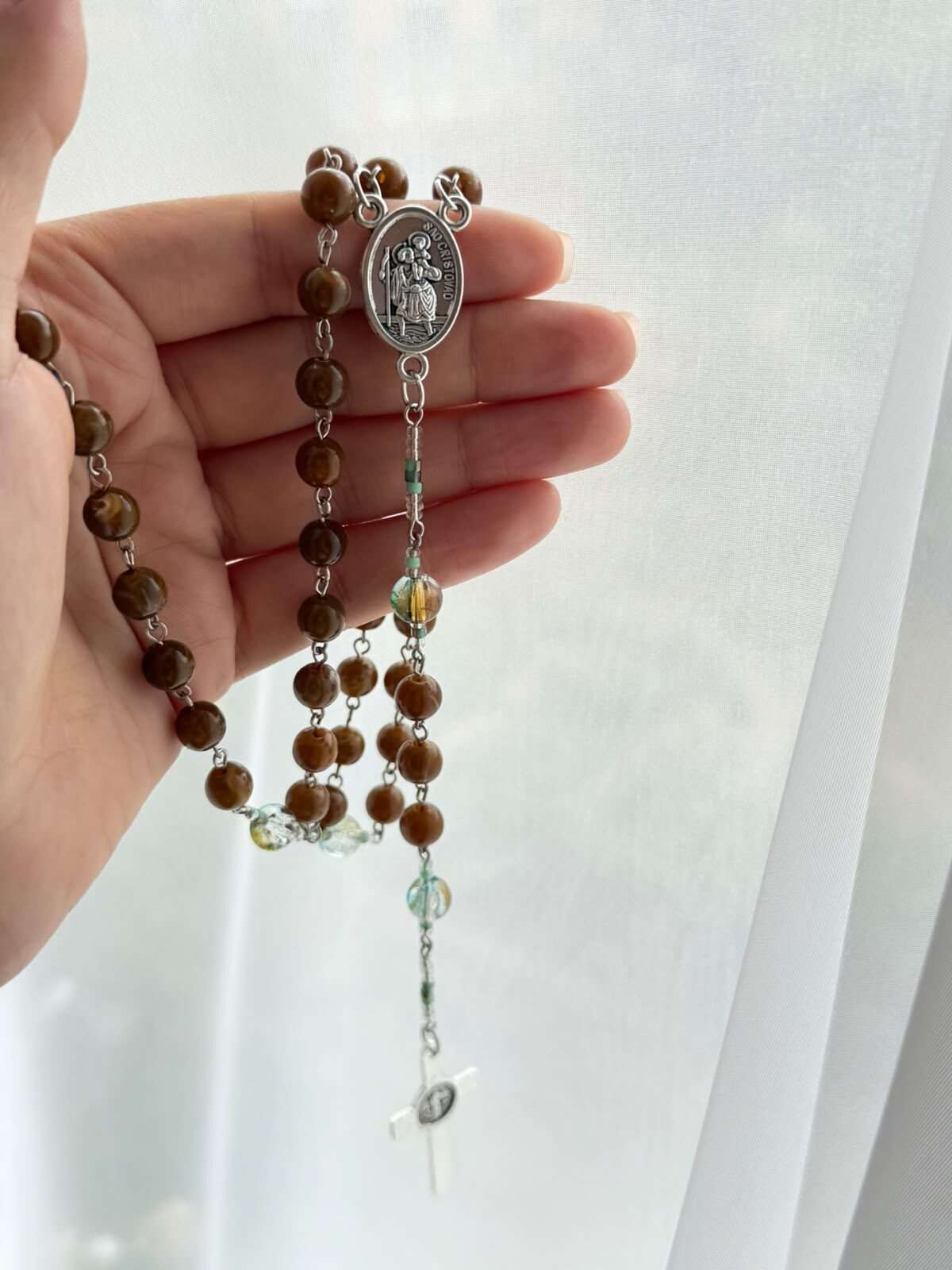
São Cristóvão
58 pounds
Buy this piece
Made by hand, so no two come out the same. A piece can be made again on request — never quite identically.
Ask about this piece- 14-day returns
Details
- Reference
- cora-0053
- Construction
- Wire-linked by hand — every bead turned onto its own eye-pin and closed
Delivery
Pieces are sent within the United Kingdom, tracked and insured, for a flat £12 added at checkout. UK law applies to your order, including 14 days to change your mind. See the shipping and returns page for handling and transit times.
Returns and repair
Fourteen days to return it. Because every link is turned and closed by hand, a single link can be reopened and put right without disturbing the rest of the strand.
For he hath given his angels charge over thee; to keep thee in all thy ways.
About this piece
São Cristóvão carries travellers, and this is the piece for a glovebox or a coat pocket. Brown and unshowy, with green and amber notes at the turns, the traveller’s own medal at the centre and a plain pale cross at the end. Every link is closed twice over — it is built to be knocked about.
Brown, and the everyday
Brown is not a liturgical colour. It has no week in the calendar and no feast of its own, and that is precisely why these two pieces exist: they are the ones made for the days in between, when nothing in particular is being marked and the prayer is said anyway. If the pale pieces are for occasions and the violet ones are for seasons, these are for the rest of it.
They are the colour of the road up to Contenças in August — warm, dusty, a little uneven from bead to bead so that no two catch the light the same way. In a strong sun the run goes almost amber. Indoors it settles to something closer to the inside of a church door. Neither is more correct than the other; it is a colour that does what the light tells it, which is the opposite of the clear pieces, where the light does what the colour tells it.
The pair here are close cousins and easy to tell apart once you know what to look for. One carries a Portuguese centre medal and small green notes at the turns, and it is the plainest thing Claudia makes: nothing on it is decorative, and its shape is the shape the object has had for four hundred years. The other carries the traveller’s own medal and ends in a plain pale cross, and it was built to be knocked about — every link closed twice over, because it is the piece most likely to spend its life at the bottom of a bag or in a glovebox.
That durability is the real argument for a brown piece. A pale run shows every mark and a cut run shows every crooked link, but a warm, uneven, low-shine strand is forgiving of being carried, dropped, and picked up again. These are not the pieces that photograph best. They are the ones most likely to still be in use in twenty years, which for an object whose whole purpose is repetition is the more important test.
Fifty-nine beads and more, each turned onto its own wire link and closed by hand, so no two come out the same.
Care and blessing
Your rosary arrives unblessed. A blessing is given freely by a priest and costs nothing — it is not ours to sell, and it never will be.
What you have paid for is the making — meticulous, by hand, link by link.